Introduction
A few years ago, most business decisions were made in conference rooms.
Managers reviewed spreadsheets, discussed reports, debated strategies, and often relied on experience and intuition to decide what to do next.
Today, something has changed.
Many companies still hold meetings, but increasingly the most valuable voice in the room isn’t a manager, consultant, or executive. It’s data.
More specifically, it’s Artificial Intelligence.
AI is transforming the way businesses make decisions by helping leaders understand information faster, identify patterns earlier, and predict outcomes more accurately than ever before. Instead of spending weeks analyzing reports, companies can now uncover insights within minutes.
The result is a new era of decision-making where speed, accuracy, and intelligence are becoming competitive advantages.
The End of Guesswork
For decades, business decisions often involved educated guesses.
A retailer estimated how much inventory to order.
A marketing team predicted which campaign might perform best.
A sales manager forecasted next quarter’s revenue.
Sometimes these decisions worked. Sometimes they didn’t.
The problem was not a lack of expertise.
The problem was a lack of information.
Modern businesses generate enormous amounts of data every day. Customer purchases, website visits, social media engagement, support requests, and financial transactions all create valuable information.
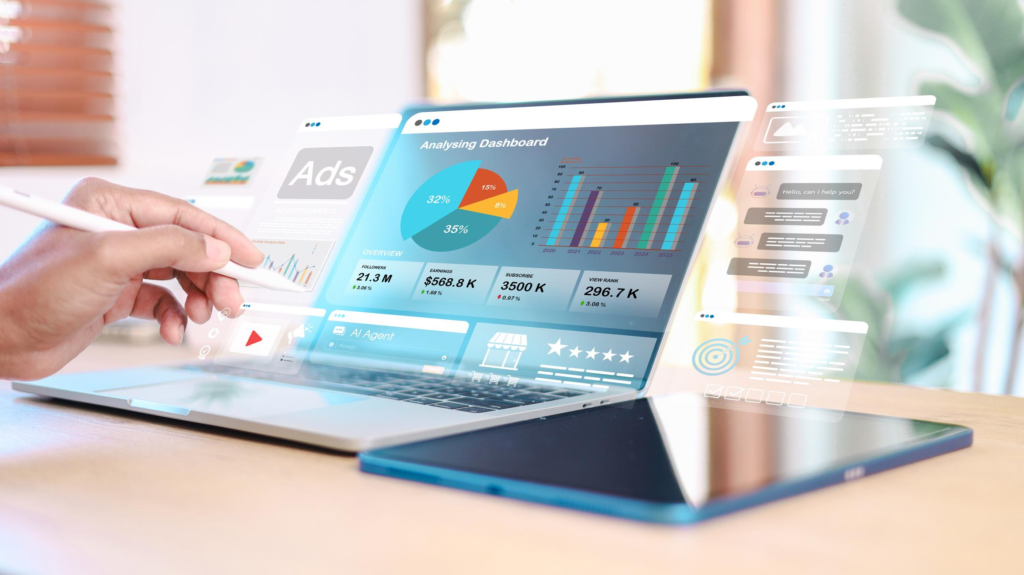
AI helps companies turn that information into actionable insights.
Instead of guessing, businesses can make decisions based on evidence.
When Data Becomes a Business Advisor
Data by itself has little value.
A spreadsheet with thousands of rows can be overwhelming.
The real value comes from understanding what the data means.
Artificial intelligence excels at identifying patterns that humans may overlook.
For example, an AI system might discover that customers who purchase a specific product are likely to buy another item within two weeks.
It may identify declining customer engagement before sales begin to fall.
It can detect operational inefficiencies hidden inside millions of records.
These insights help leaders make smarter decisions before problems become expensive.
Faster Decisions in a Faster World
Business moves quickly.
Consumer preferences change.
Competitors launch new products.
Market conditions shift unexpectedly.
Companies that wait too long to make decisions often lose opportunities.
AI helps organizations respond faster by analyzing information in real time.
Traditional vs AI-Powered Decision Making
| Traditional Approach | AI-Powered Approach |
|---|---|
| Manual analysis | Automated analysis |
| Days or weeks to review data | Insights within minutes |
| Limited data processing | Massive data processing |
| Reactive decisions | Predictive decisions |
| Higher risk of human error | Improved accuracy |
Speed has become one of AI’s most valuable advantages.
How AI Helps Marketing Teams
Marketing has always involved understanding people.
The challenge is that customer behavior constantly changes.
Artificial intelligence allows marketing teams to identify trends, preferences, and opportunities much faster than traditional methods.
AI in Marketing Decisions
- Predicting customer interests
- Personalizing advertisements
- Optimizing email campaigns
- Improving social media strategies
- Measuring campaign effectiveness
Instead of creating one message for everyone, companies can deliver more relevant experiences to specific audiences.
This often leads to better engagement and higher conversion rates.
Smarter Sales Forecasting
One of the most difficult challenges in business is predicting the future.
How much will customers spend next month?
Which products will perform best?
What risks could impact revenue?
AI helps answer these questions by analyzing historical patterns and market trends.
Rather than relying entirely on assumptions, companies can make forecasts supported by data.
This allows organizations to plan more effectively and reduce uncertainty.
Customer Behavior Is Becoming More Predictable
Every customer leaves behind digital clues.
Website visits.
Product searches.
Purchase history.
Support interactions.
Social media activity.
AI systems analyze these behaviors to identify patterns and predict future actions.
Businesses can then make decisions based on what customers are likely to do rather than what they hope customers will do.
This creates more efficient marketing, better customer experiences, and stronger business performance.
AI in Human Resources
Hiring the right people has always been one of the most important business decisions.
Artificial intelligence is helping companies improve recruitment processes by identifying qualified candidates more efficiently.
AI can assist with:
- Resume screening
- Candidate matching
- Interview scheduling
- Workforce planning
- Employee performance analysis
This allows human resource teams to focus more on people and less on administrative tasks.
Risk Management in the Age of AI
Every business faces risks.
Financial risks.
Operational risks.
Security risks.
Market risks.
The challenge is identifying potential problems before they become serious.
Artificial intelligence helps organizations detect warning signs early.
For example, banks use AI to identify unusual transactions that may indicate fraud.
Manufacturers use AI to predict equipment failures before they occur.
Retailers use AI to monitor supply chain disruptions.
The ability to anticipate problems gives businesses a significant advantage.
Why Small Businesses Are Joining the AI Revolution
Artificial intelligence was once considered a tool reserved for large corporations.
That is no longer true.
Affordable AI platforms now allow small businesses to access powerful capabilities that were previously available only to major enterprises.
Popular AI Applications for Small Businesses
| Business Area | AI Use Case |
| Customer Service | Chatbots and automated support |
| Marketing | Content creation and campaign optimization |
| Sales | Lead generation and forecasting |
| Operations | Workflow automation |
| Finance | Expense tracking and reporting |
As AI tools become more accessible, smaller organizations can compete more effectively in crowded markets.
Can AI Make Better Decisions Than Humans?
This question often sparks debate.
The answer is not simple.
AI can process more information than any human.
It can identify patterns, detect trends, and perform complex calculations at remarkable speed.
However, business decisions involve more than data.
They require judgment.
They require ethics.
They require creativity.
They require understanding human behavior.
The most successful organizations do not replace human decision-makers with AI.
Instead, they combine human experience with artificial intelligence.
The result is often better than either could achieve alone.
The Future of Business Decision-Making
Imagine a future where business leaders receive recommendations before they ask questions.
Sales forecasts update automatically.
Market risks are identified instantly.
Customer trends appear in real time.
Strategic decisions are supported by intelligent systems operating continuously in the background.
That future is already beginning to emerge.
Companies that embrace data-driven decision-making are often better positioned to adapt, innovate, and compete.
The goal is not to remove humans from decision-making.
The goal is to give humans better information.
Conclusion
Artificial intelligence is changing the way companies make decisions by transforming data into actionable insights. From marketing and sales to recruitment and risk management, AI helps businesses respond faster, operate more efficiently, and understand customers more deeply.
While human judgment remains essential, organizations that combine experience with intelligent technology are discovering new opportunities for growth and innovation.
The future of business decision-making will not belong entirely to humans or machines.
It will belong to those who learn how to use both together.